

Sirāt
interpreting the fever-nightmare of the decade

SPOILER WARNING FOR THE FILM. SUFFICE TO SAY, I QUITE LIKED IT AND WOULD RECOMMEND EVERYONE SEE IT ONCE IT’S MORE PUBLICLY AVAILABLE. ONLY READ ON IF YOU’VE SEEN THE MOVIE OR DON’T CARE ABOUT SPOILERS.
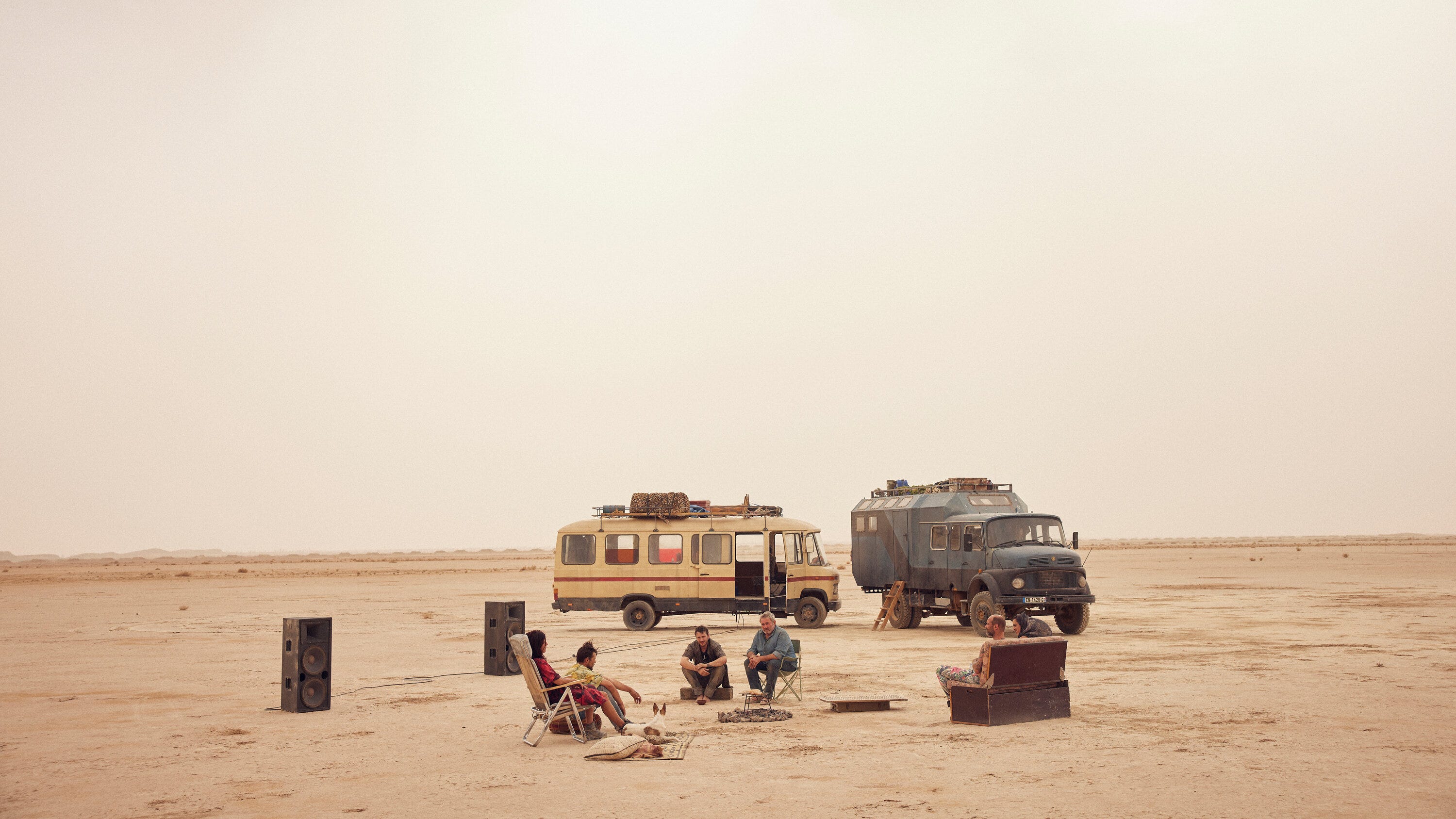
A pulsating, endless exercise in emotional endurance, Sirāt is an arthouse thriller that — on its surface — would appear to be a rather straightforward adventure about a father on the search for his missing daughter across the vast deserts of southern Spain/northern Morocco, only for his journey to collide with a wandering caravan of nomads who host impromptu electronic music festivals out of their RVs.
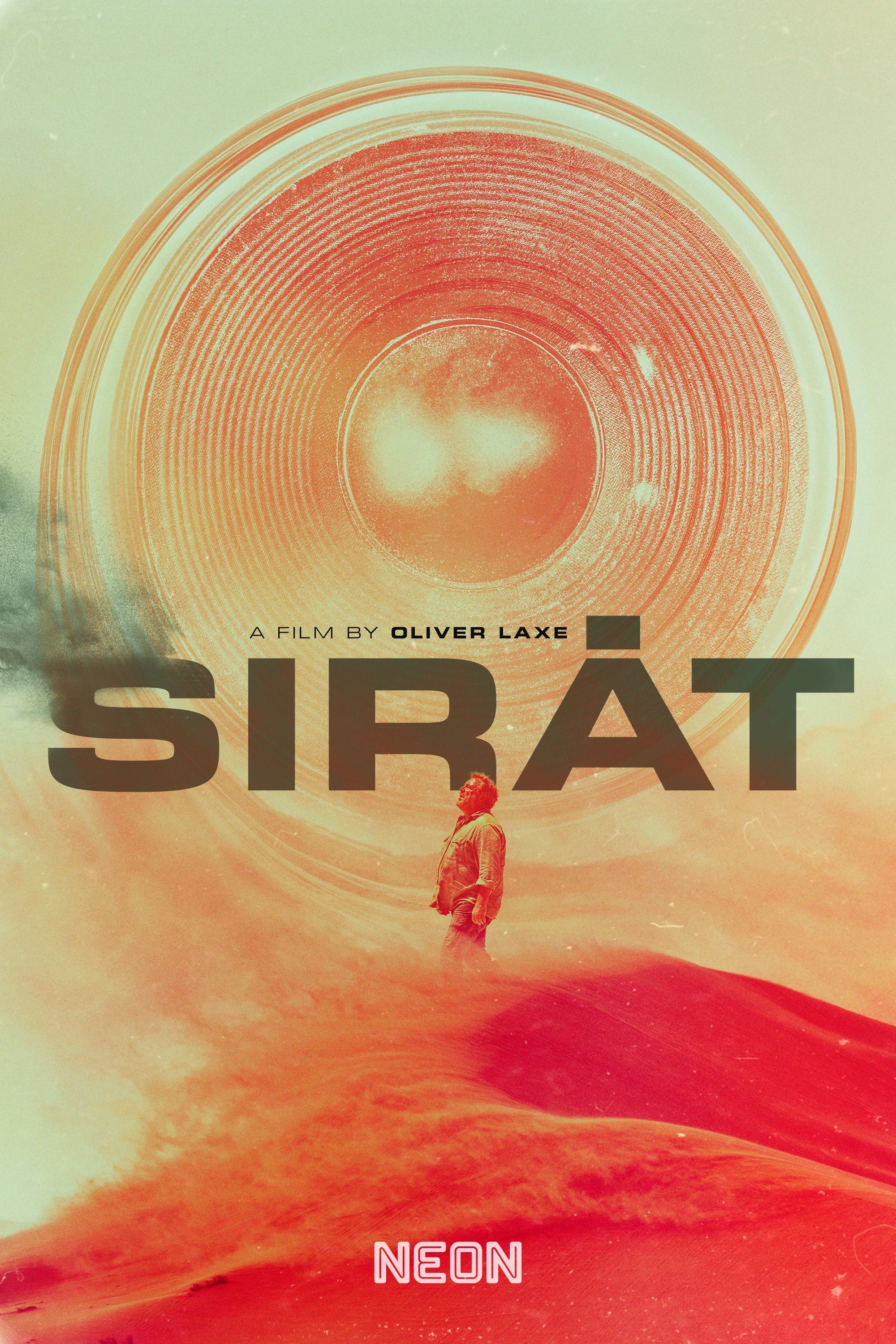
Sirāt is simply not at all what the trailer portrays itself as, and it is also NOT for the faint of heart.
The premise of the film — the aforementioned father and his preteen son arriving at a music festival in the desert hosted by a group of hippies (for lack of a better term) with impressive musical equipment and a cadre of RVs — only applies to the first ten minutes or so.
From there on, Sirāt becomes something else entirely — and something that’s much more difficult to describe.
What starts as a simple mystery, as both the father and son share pictures of the missing girl with the nomads and are left with a hollow desperation as it appears no one has ever seen this person — they’re given a small dose of hope when one woman says the pack of nomads are about to pack up and travel to the “next festival” far off in the desert, and if the missing girl is anywhere, she’s surely there.
The party is then immediately broken up by the EU and their foot soldiers (already odd…) and before being processed, the father and son follow the nomads closely and ultimately escape from the soldiers and carry on with their race for the next festival, through the mountains and deeper into the desert.
And that’s when the film begins to force you to consider the oddity of this world.
Whenever they turn on the radio, there is news of World War III breaking out in Europe. There are lines of migrating Muslim families waiting for gas, water, and food at a passing petrol station. The EU is clearly utilizing a military force (again, wat?) to restrain and apprehend undesirables across desert and near the railroads.
Are we in the apocalypse? Is this the future? An alternate reality?
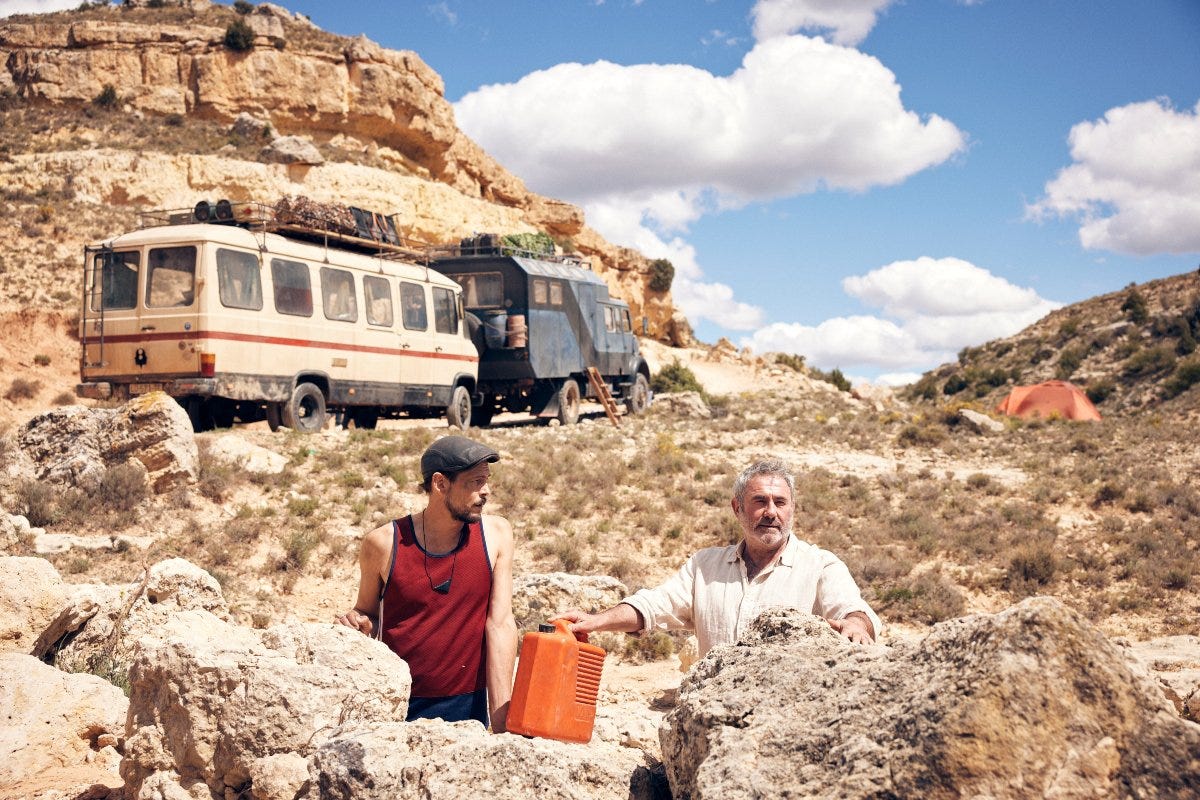
Before we can get clearer answers, the father, his son, their dog, and the nomads decide to take the road less traveled — up a steep and rocky mountain path — to avoid the soldiers and reach the next festival faster.
And then all hell is unleashed.
The title Sirāt comes from a mythical bridge in the Hadith (Islamic text) that every soul must pass on the day of resurrection, and prove themselves worthy of paradise. As per the film’s opening credits, the bridge is “thinner than a strand of hair, and as sharp as the sharpest sword.”
From the moment the nomads and the family choose to take the mountain pass, they condemn themselves to cross a metaphorical form of the bridge, as the physical path becomes perilous, and ultimately leads to the greatest emotional strife conceivable.
At around the halfway point of the film — well after the nomads have established a friendly rapport with the father and son, including one woman in particular who is clearly meant to be a stand-in for the missing daughter as she speaks very similarly of her love for music and yearning for freedom — one of the RVs gets caught on the mountainside. While the father attempts to help the nomads free the RV, he commands his son and dog to go back to their van and wait, wherein a very stressful game of mountainside Fetch occurs, giving everyone in the theater a proper panic attack.
And, as you might imagine, that’s when the movie goes to hell.
Immediately after the RV is freed, the father turns to find the son has accidentally released the handbrake on the van, and both the son and the dog plunge over the cliff. There is no heroic moment. No chance for survival. Because the movie is so focused on music and sound, there is an explicit choice to make you hear every sickening thud of the van smashing into the side of the mountain two, three, four times in a row. Only one nomad looks out over the ledge (we never see anything), and his reaction confirms the worst.
There is NO coming back from Sirāt after this moment. The stakes, which were mercurial and obscured before, are now demonstrably and upsettingly clear.
We are watching a horror film.
While the next twenty minutes or so are devoted to the void left behind by the passing of the son and the dog, as both the father and all the nomads try to reconcile with the morbid choice to carry on with their mission, Hell has no patience for the group.
In a deeply powerful moment where the nomads try to ‘ground’ the father to the world once more, they host an improve electronic music session in the middle of the open desert, shaking the ground with massive speakers and a transcendental bassline (the incredibly addictive score courtesy of Kangding Ray) that lulls them all into a hypnotic dance.
Only for them to find out the hard way that they’ve ventured into a minefield.
And then, one by one, all but two of the nomads are killed in horrific explosions as they fail to navigate their way back to safety.
Left with nothing and with no chance of finding his daughter, the father closes his eyes and blindly sprints through the desert and miraculously manages to find safety among the rocks on the far side. The last two nomads (with their own dog) follow suit — walking painfully slowly but with their eyes closed — and manage to make it to safety after giving up any hope of control or understanding.
The movie ends with the three survivors on a train with a large group of migrants on the way out of Morocco (Spain, whatever) and hopefully towards somewhere safer.
Upon the credits rolling, I was initially disappointed.
I had been so hooked by this movie’s premise, its tremendous score and visual flair, and its jaw-dropping decisions to slowly kill off most of the cast, that I fully expected that there was still another fifteen minutes left in the movie wherein the father would finally be able to find out what happened to his missing daughter.
But instead, the movie just ends.
And an ending like that is designed to make you stop and go, “wait, was there a missing daughter? Was there another festival? Was this even really happening?!”
THAT is Sirāt’s greatest asset — the notion that the first half of the film feels so literal and traceable and tangible, only to have the second half completely rip out your guts entirely, and then for the movie to end prematurely so that you don’t get your hopes up about an answer that you were never meant to be given in the first place.
Given the religious subtext (err, text, really) of the film’s premise, it doesn’t feel like a stretch to assume that ending is meant to suggest that entirety of the film is A metaphor of some kind…Not to say that the father and son are necessarily in the afterlife (the titular bridge) from the getgo, nor is that to say there’s a definitive point in the film that they magically cross the threshold from reality into the spiritual realm, but rather, I think the story of Sirāt is meant to be a sort of parable. A cautionary tale about obsession and misunderstanding of one’s life.
Repeatedly, throughout the film, both the son and the nomad who grows closest to the father (the stand-in for his daughter) mention that the missing daughter clearly DOES NOT WANT to be found. It’s established that she’s an adult, she left of her own accord, and she sought a sort of freedom from this hellish world that only music could offer. When the nomad fixes up an old speaker and tests it with thudding electronic music, the father mentions how he can’t understand how anyone can listen to it, and the nomad responds that “you’re not suppose to listen to this, you’re supposed to dance to it.”
The motif being, “don’t think too much about life. Just experience it.”
Perhaps a lesson that the missing daughter came to understand or was on a pilgrimage in search of, and a lesson that the father had never let himself consider, all made manifest by the impromptu dance session in the minefield that does manage to bring out emotional movement from everyone in the group — even the father, to some extent — until it becomes such that the escapism itself becomes more important than life, and the group loses their way once more.
To close his eyes and blindly sprint through the minefield is the only time the father succeeds in anything, and it has nothing to do with his missing daughter or deceased son. It is him and him alone, trying to make his way across a perilous path that cares not for understanding, plans, analysis, or problem solving. (This is actually further reiterated during the minefield scene when the nomads try to rig their RV to drive itself so they can use its imminent destruction to clear a path…and the plan ultimately fails.)
Dancing, not hearing.
And maybe that IS the next festival, where his missing daughter has been all this time. Somewhere across the narrow bridge, where the dancing is all that matters.
A reach perhaps, but one that I think the movie begs for, because reading Sirāt in the most literal form would lead to a very upsetting, bleak, and hopeless answer aboutlife and how we handle the misery that befalls us…
Which is a common complaint I see in the negative reviews for this film, and if you see it that way, I can understand why you would hate it.
And I’m not exactly a religious fellow, so far be it for me to put much faith in any dogmatic literature, but at the same time, I do often find some kind of beauty and hope in the poetry of beliefs, and to that extent, I’m willing to cross the narrow bridge of Sirāt that Islam has put forward, if only to believe that, in this specific instance, maybe there’s a paradise filled with gorgeous music on the other side.